3 most expensive grandfather clocks in the world
Hi, dear reader! today we will talk about the Top 3 most expensive grandfather clocks in the world. Imagine a clock so intricate and valuable that it feels more like a priceless piece of art than just a timekeeper. From hands that seem to float in mid-air to dazzling chimes that echo centuries of craftsmanship, these grandfather clocks aren’t just about telling time; they’re about capturing history, innovation, and luxury in every tick.
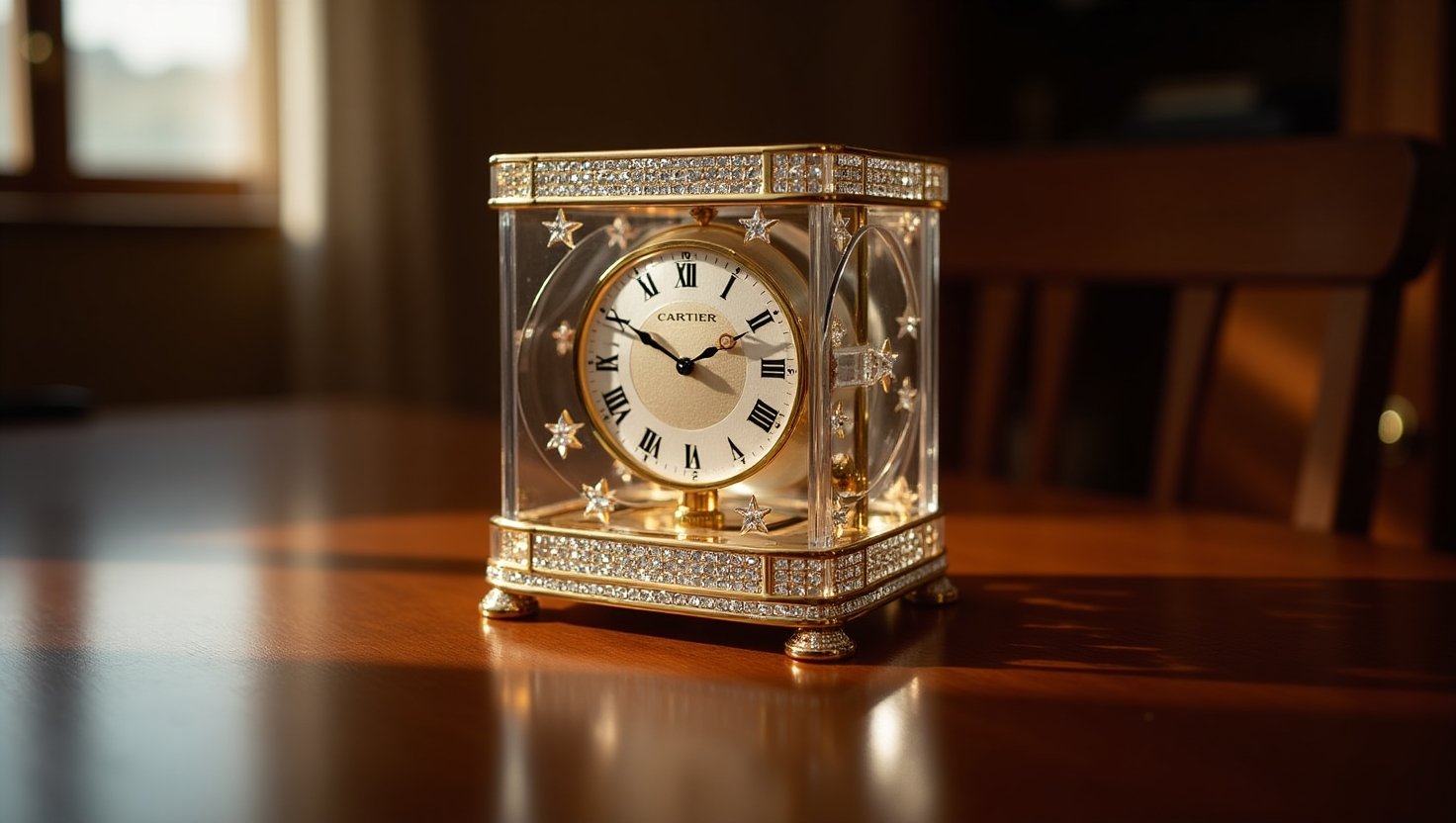
Cartier Mystery Clock: The $4.2 Million Timepiece That Defied Physics
Imagine looking at a clock and seeing its hands floating, no gears, no visible movement, just time suspended in the air. That’s exactly what the Cartier Mystery Clock (Tortue Model) does. Sold for$4.2 million, it’s not just a timekeeper, it’s a masterpiece of illusion, craftsmanship, and timeless beauty. This legendary clock didn’t just tell time; it told the world that magic and mechanics could exist in one breathtaking creation.
Historical Significance and Design
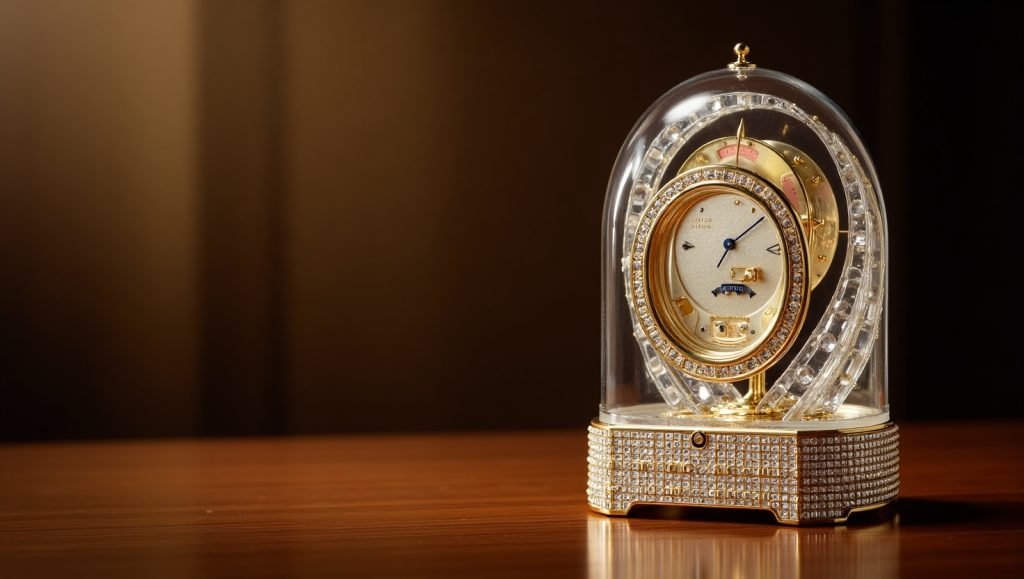
Back in the 1920s, Paris was buzzing with creativity. The city was alive with music, fashion, and bold new ideas. It was during this exciting time that Cartier, already known for its luxury jewelry, introduced a new kind of timepiece, the Mystery Clock. What made it so special? Its hands appeared to float, without any visible connection to gears or mechanisms. It was like looking at a magic trick… every minute of the day.
The Tortue Model, named after the French word for “turtle” because of its rounded, shell-like shape, was one of the rarest of these clocks. Only a few were ever made. It combined elegant design with brilliant engineering. The design was dreamed up by Louis Cartier, and the movement was crafted by Maurice Couët, a clockmaker who was deeply inspired by the 19th-century illusionist and inventor Jean-Eugène Robert-Houdin. Houdin created the first “mystery” clocks, and Cartier brought the idea into the luxury world.
But why did Cartier bother with a clock that seemed like an illusion? Because they weren’t just selling time, they were selling awe, elegance, and innovation. Every part of the clock was designed to impress: the shape, the materials, the floating hands. It was a conversation piece for the elite, and it showed off the very best of Cartier’s ability to mix art and engineering.
Fewer than 90 of theseclocks were made between 1913 and 1930, and even fewer Tortue models exist today. Each one took months of work by a team of goldsmiths, gem-setters, and clockmakers. Every detail was crafted by hand. It wasn’t just a clock; it was a piece of history.
Art Deco masterpiece from the 1920s
The 1920s were all about bold, modern design, clean lines, geometric shapes, and glamorous style. That’s what we now call Art Deco, and the Cartier Mystery Clock is a perfect example of it.
Unlike traditional square or round clocks, the Tortue model had a soft, curved shape that felt both unique and sophisticated. The face of the clock usually featured Roman numerals, often decorated with enamel or fine patterns. The materials were elegant, but the real beauty was in how everything worked together so smoothly.
This clock wasn’t meant to blend into the background. It was made to stand out, to sit proudly in a luxurious home, and spark conversations. Even today, it captures the spirit of the 1920s, a time when art and function came together most beautifully.
Revolutionary transparent dial mechanism
The real magic of the Mystery Clock was in its clear face. The hour and minute hands were connected to two see-through crystal discs, which rotated without showing how they were powered. The gears were cleverly hidden in the base of the clock, so from the front, it looked like the hands were floating in space.
This wasn’t just a gimmick. It was precise, genius-level engineering, and it had to be perfect. Even the tiniest error in alignment could ruin the illusion. That’s why these clocks took months to complete.
Cartier’s innovative clockmaking legacy
Cartier wasn’t just making pretty clocks; they were pushing boundaries. This kind of innovation showed that Cartier could do more than make jewelry; they could change the way people thought about time itself.
The Mystery Clocks were never mass-produced. Each one was custom-made, usually for royalty or wealthy collectors. Maurice Couët, the man behind the movement, worked with Cartier for years and helped build its reputation as a true innovator in the world of luxury timepieces.
Even now, the Mystery Clock is seen as a symbol of Cartier’s bold vision and technical genius.
Auction Records and Valuation
In recent years, one of the Cartier Tortue Mystery Clocks was put up for auction and the world took notice. This wasn’t just another antique. Collectors knew how rare it was, and how perfectly it represented a golden era of design.
When the bidding ended, the clock had sold for an astonishing $4.2 million. That wasn’t just a big number it was a clear message: these clocks are more than beautiful objects. They’re pieces of horological art, and owning one is like owning a piece of magic.
Today, the value of these clocks keeps climbing. As more collectors discover their rarity and craftsmanship, they become even more desirable.
Sotheby’s record-breaking sale details
The clock that sold for $4.2 million was auctioned at Sotheby’s in Geneva, one of the most prestigious watch and clock auctions in the world. Experts had expected it to sell for around $1 million, but the final price was over four times higher.
What made it so valuable? It was in perfect condition, with all original parts. It came from a private collection and had been carefully preserved for decades. For collectors, this was a once-in-a-lifetime chance.
The winning bid came from an anonymous buyer, but the mystery only added to the clock’s legend.
Market impact on luxury timepieces
This sale changed the game for luxury clocks. Suddenly, more people started paying attention to decorative timepieces, not just watches. Collectors began hunting for other Mystery Clocks, and even modern brands were inspired to experiment with see-through dials and hidden movements.
Cartier’s legacy grew even stronger, proving that innovation never goes out of style. The Tortue Clock didn’t just break records; it revived interest in the art of clockmaking itself.
Craftsmanship and Materials
The Cartier Mystery Clock wasn’t just clever, it was breathtakingly beautiful. Every part of it was made from the finest materials by some of the best artisans in the world.
These clocks weren’t made in a factory. They were created by teams of goldsmiths, jewelers, glass cutters, and watchmakers, all working together to build something truly special.
18-karat gold and platinum construction
The base and frame of the Tortue Clock were made from 18-karat gold and platinum, materials chosen not just for their value, but for their durability and elegance. Every edge was polished by hand. Every curve was measured and balanced.
These metals weren’t just decoration; they were a symbol of status and quality. And even after 100 years, they still shine.
Hand-cut crystal and precious gemstones
The transparent face of the clock was crafted from rock crystal, a pure form of quartz that was cut and polished until it was completely clear. This allowed the illusion to work perfectly. Some clocks also featured diamonds, sapphires, or other gemstones, placed with incredible precision.
These weren’t just fancy details. They were part of the story, each material chosen for beauty, clarity, and meaning.
Breguet Grande Complication: The $3.8 Million Horological Marvel
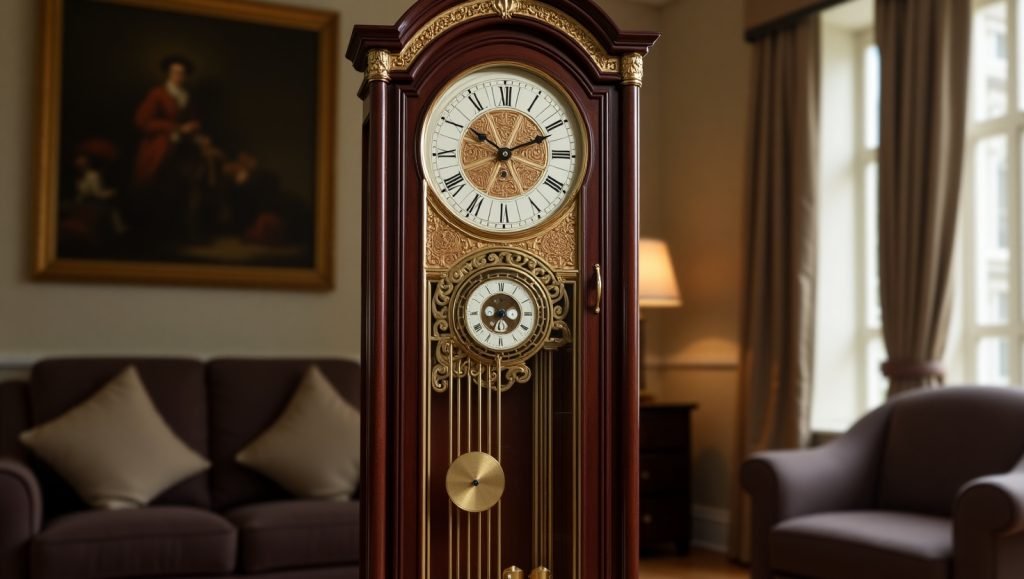
The Breguet Grande Complication Grandfather Clock isn’t just a luxury item; it’s a mechanical masterpiece that commands both respect and wonder. Valued at $3.8 million, this clock brings together over two centuries of precision engineering, artistry, and innovation. It stands tall like a monument to time itself, quietly showcasing some of the most complex mechanical features ever built into a clock.
Technical Innovation and Complexity
What makes this grandfather clock truly incredible isn’t just its elegance or value; it’s the unbelievable amount of mechanical genius packed inside it.
At first glance, you see a tall, graceful cabinet. But inside? It’s like a miniature universe, filled with tiny moving parts all working together. The clock includes what watchmakers call complications, extra features beyond just telling time. And this one has a lot of them.
The most impressive? A perpetual calendar that knows exactly how many days are in each month, even during leap years, without needing to be reset. That alone is a rare feature, but it doesn’t stop there.
You also get astronomical indicators like sunrise and sunset times, moon phases, and even the equation oftime, which tracks the difference between clock time and solar time (yes, that’s a real thing!). This clock is practically a built-in observatory.
All of these features are powered by an intricate mechanical system, no batteries, no digital screens. Instead, it runs on pure craftsmanship: gears, springs, and levers, all precisely arranged by hand. The engineers even used a fusee and chain system, an old-school method that ensures the power delivered is smooth and consistent as the clock runs.
And then there’s the sound. The chimes are tuned by hand to give deep, cathedral-like tones. Every hour, it doesn’t just mark the time; it fills the room with music.
Multiple complications, including a perpetual calendar
Imagine a calendar that never needs to be changed, even in February. That’s what the perpetual calendar inside this clock does. It shows the correct date, day of the week, month, and even knows when leap years happen. You can leave it untouched for decades, and it will stay accurate.
Most clocks and watches can’t pull this off. But Breguet built this feature to make the clock future-proof, a true mark of high horology.
Astronomical displays and moon phases
One glance at the dial, and you’ll see more than just time. The clock includes a moon phase display that shows the current stage of the moon: waxing, waning, full, or new. It even tracks sunrise and sunset times, adjusting them based on the time of year.
This isn’t just decorative. It’s designed for those who love the poetic side of time, how it connects to nature and the sky.
Mechanical movement engineering secrets
What powers all this? A mechanical brain built by hand. Inside, a highly engineered movement manages everything with perfect timing. The parts are made of durable materials like brass and steel, hand-polished to reduce friction and extend lifespan.
Each wheel and lever is designed with intention, and the movement is so precisely built that it can keep ticking for decades with very little maintenance.
Heritage and Provenance
Behind every great timepiece is a great story, and this one starts with Abraham-Louis Breguet, the legendary watchmaker from the 18th century. Breguet was a genius whose inventions changed the world of timekeeping. He created the first wristwatch, pioneered the tourbillon, and designed timepieces for kings and queens.
This clock follows that same tradition; it’s the spiritual heir to Breguet’s legacy. Every detail reflects the kind of precision and elegance he was known for.
Abraham-Louis Breguet lineage legacy
Owning this clock is like owning a piece of horological history. It’s inspired by the groundbreaking techniques Breguet invented over 200 years ago, like the use of temperature-adjusted balance wheels and shock protection systems that are still in use today.
This clock isn’t just built in Breguet’s name; it continues his mission to push the limits of mechanical timekeeping.
Royal family ownership history
Pieces like this don’t just belong to collectors; they’ve been owned by royalty. Historically, Breguet’s creations have adorned the homes of French kings, Russian czars, and British nobles. While this particular model is ultra-rare, similar clocks by Breguet have been commissioned by and passed down through elite families.
When you see this clock, you’re looking at something that fits in a palace and often has.
Investment Value and Rarity
Beyond its beauty, this clock holds serious value for collectors. It’s not just a showpiece, it’s an investment that grows in worth over time.
Limited production of only 12 pieces
One of the biggest reasons for its high value? Only 12 of these clocks exist in the entire world. That makes it ultra-rare, and rarity always drives up collector interest. Each one was handcrafted, and no two are exactly alike. That level of exclusivity is why it’s considered a trophy item in the world of fine horology.
Current market valuation trends
Luxury mechanical clocks are experiencing a revival among high-end collectors, and Breguet’s pieces are especially in demand. Auction prices have steadily increased, and private sales often exceed official estimates.
With collectors looking for unique, historically rooted mechanical art, clocks like this are seen not just as timekeepers but as long-term stores of value.
In short, the Breguet Grande Complication Grandfather Clock is more than just a clock; it’s a living, ticking sculpture. A fusion of art, science, and heritage. Whether you’re a seasoned horologist or someone who simply admires genius, this piece makes one thing clear:
Patek Philippe Grandmaster Chime: The Ultimate Horological Achievement
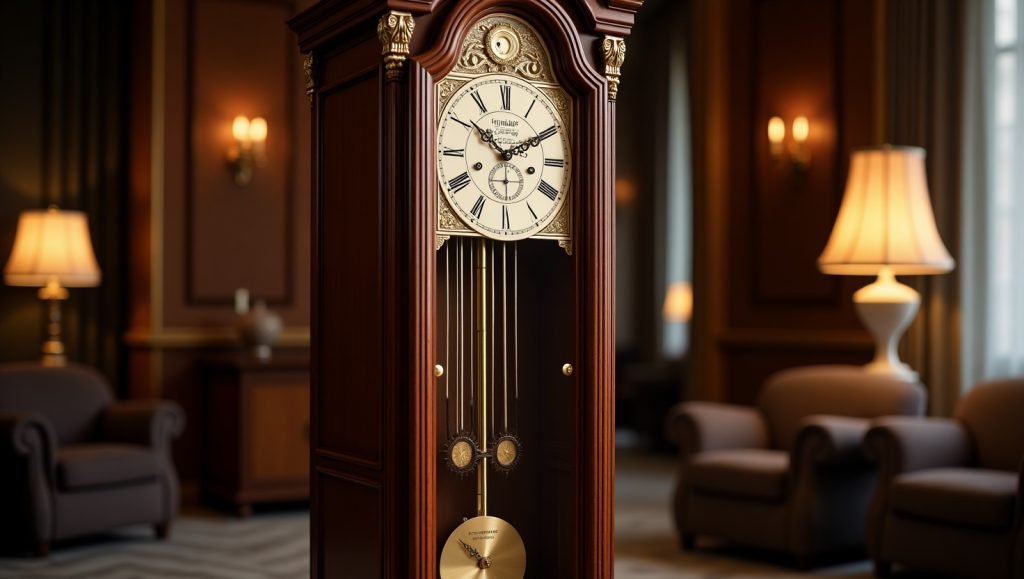
The Patek Philippe Grandmaster Chime Floor Clock isn’t just a timekeeping instrument; it’s a cathedral of mechanics, a standing tribute to centuries of Swiss precision and artistry. Priced in the multi-million-dollar range and rarely seen outside of private salons or exclusive exhibitions, it represents the very peak of what horology can achieve, where engineering becomes poetry.
Mechanical Excellence and Features
The Grandmaster Chime Floor Clock is more than a statement piece. It’s a mechanical symphony built to astonish. Every inch of its interior is packed with gear trains, cams, levers, and bridges hand-finished, decorated, and assembled to perfection.
What makes this timepiece extraordinary is its 20 complications, packed into one vertically standing marvel. Most luxury wristwatches celebrate having four or five complications. Here, Patek Philippe has engineered twenty without compromising accuracy, elegance, or chime quality.
Among them: a perpetual calendar, moon phases, a minute repeater, a second time zone, and even a day-night indicator. These aren’t just gimmicks. They’re executed with purpose and aesthetic harmony. No dial feels crowded. No function feels forced.
The mechanical movement that powers this masterpiece is designed from the ground up with over 1,300 components working in tandem inside a cabinet crafted from rare woods, hand-finished metal, and in some models, even precious stones.
20 complications in a single timepiece
Packing twenty high-precision complications into a single mechanical unit is a feat only a handful of brands could even dream of, and Patek Philippe pulled it off without making sacrifices. The calendar mechanism alone requires its own integrated memory system to account for leap years, month lengths, and moon cycles.
Then there’s the dual-time zone feature, complete with synchronized day/night indicators, which are ideal for collectors who travel the world but remain grounded in tradition.
Each complication has its own mechanical subsystem, and yet, all of them are harmonized within a movement so refined it can run continuously for decades with proper care.
Chiming mechanism with multiple melodies
The Grandmaster Chime doesn’t just track time, it sings it. At the top of each hour and on demand, the clock produces a series of rich, layered melodies, thanks to its multiple gongs and hammers.
These aren’t ordinary chimes. Patek Philippe has tuned them like musical instruments, with some Grandmaster models offering custom chime patterns. The depth, clarity, and resonance feel like a concert inside your home, one that plays at the stroke of every hour.
Complex gear train architecture
What keeps everything synchronized is a sophisticated gear train network, composed of hundreds of gears, each calibrated for zero tolerance. The torque management system ensures that all complications operate seamlessly, even when activated simultaneously.
Hidden deep within are secret transmission layers that allow functions to “communicate” with each other without mechanical interference. It’s a layered symphony of motion beneath an elegantly simple face.
Brand Legacy and Reputation
Patek Philippe doesn’t follow trends; it sets them. The Grandmaster Chime Floor Clock reflects nearly two centuries of unbroken dedication to the highest form of horology. It’s not built for mass production or mass appeal. It’s built to preserve and elevate the very soul of Swiss watchmaking.
Swiss horological tradition since 1839
Founded in 1839, Patek Philippe remains family-owned, a rare distinction that allows it to maintain full control over quality, design, and tradition. The techniques used to build the Grandmaster Chime Floor Clock were passed down across generations, refined in their Geneva ateliers, and applied only by their most senior master watchmakers.
This is Swiss heritage not just in branding, but in discipline and detail.
Museum-quality craftsmanship standards
Every Grandmaster Chime clock could belong in a museum. In fact, several are showcased in Patek Philippe’s private Geneva museum. The floor clock’s movement is often described as “haute horlogerie in architectural form”, due to its structure, scale, and artisanal finishing.
Each piece undergoes thousands of hours of manual finishing, from Geneva striping to anglage (beveled edges), mirror polishing, and hand-engraving. Even screws, hidden from view, are polished to perfection.
Market Performance and Collectibility
Collectors don’t just buy this clock, they wait for it. With limited availability, almost no public listings, and strict vetting from Patek Philippe’s private client division, getting one is often more difficult than affording one.
15% annual appreciation rate
Over the past decade, Patek Philippe’s rarest pieces, including Grandmaster Chime variants, have shown a consistent 12–15% annual appreciation, outperforming many traditional investment assets. This isn’t just about resale value, it’s about owning something that gets rarer, and more respected, every year.
Exclusive collector ownership circle
Only the most elite collectors own a Grandmaster Chime Floor Clock. We’re talking heads of state, royalty, and names you’d find in the Forbes billionaire list. For many, owning this clock is the final jewel in a lifelong collection of horological treasures.
It isn’t just a purchase. It’s a rite of passage in the highest echelon of mechanical connoisseurship.
In summary, the Patek Philippe Grandmaster Chime Floor Clock stands in a league of its own. It’s not just a feat of mechanical complexity; it’s a symbol of excellence, patience, and legacy. For those who truly understand time, this is the clock that defines it.
Conclusion
The Cartier Mystery Clock, the Breguet Grande Complication, and the Patek Philippe Grandmaster Chime are not just expensive clocks; they’re amazing works of art and engineering. Each one tells its own unique story: Cartier’s clock fascinates with its “floating” hands, Breguet’s clock impresses with its many smart features like the moon phases and calendar, and Patek Philippe’s clock amazes with its incredible complexity and beautiful chimes.
What makes these clocks truly special isn’t just their price or their looks; it’s the care, skill, and creativity that went into making them. They show how humans can turn something as simple as tracking time into a masterpiece that connects us to history, craftsmanship, and beauty.
Whether you’re a collector or just someone who loves fine things, these clocks invite you to appreciate more than just the hours ticking by; they remind us to enjoy the magic behind every moment.
In short, these grandfather clocks aren’t just about time; they’re about passion, skill, and the amazing stories time can tell.












Post Comment